Soft One delivers high-precision, hot-applied thermoplastic road marking services across Doha and Qatar. Formulated with premium hydrocarbon resins and premix reflective glass beads, our screeded and sprayed markings withstand high-traffic shear stress and 50°C+ summer surface temperatures in full compliance with QCS 2014 Section 6 and Ashghal IAN 014.
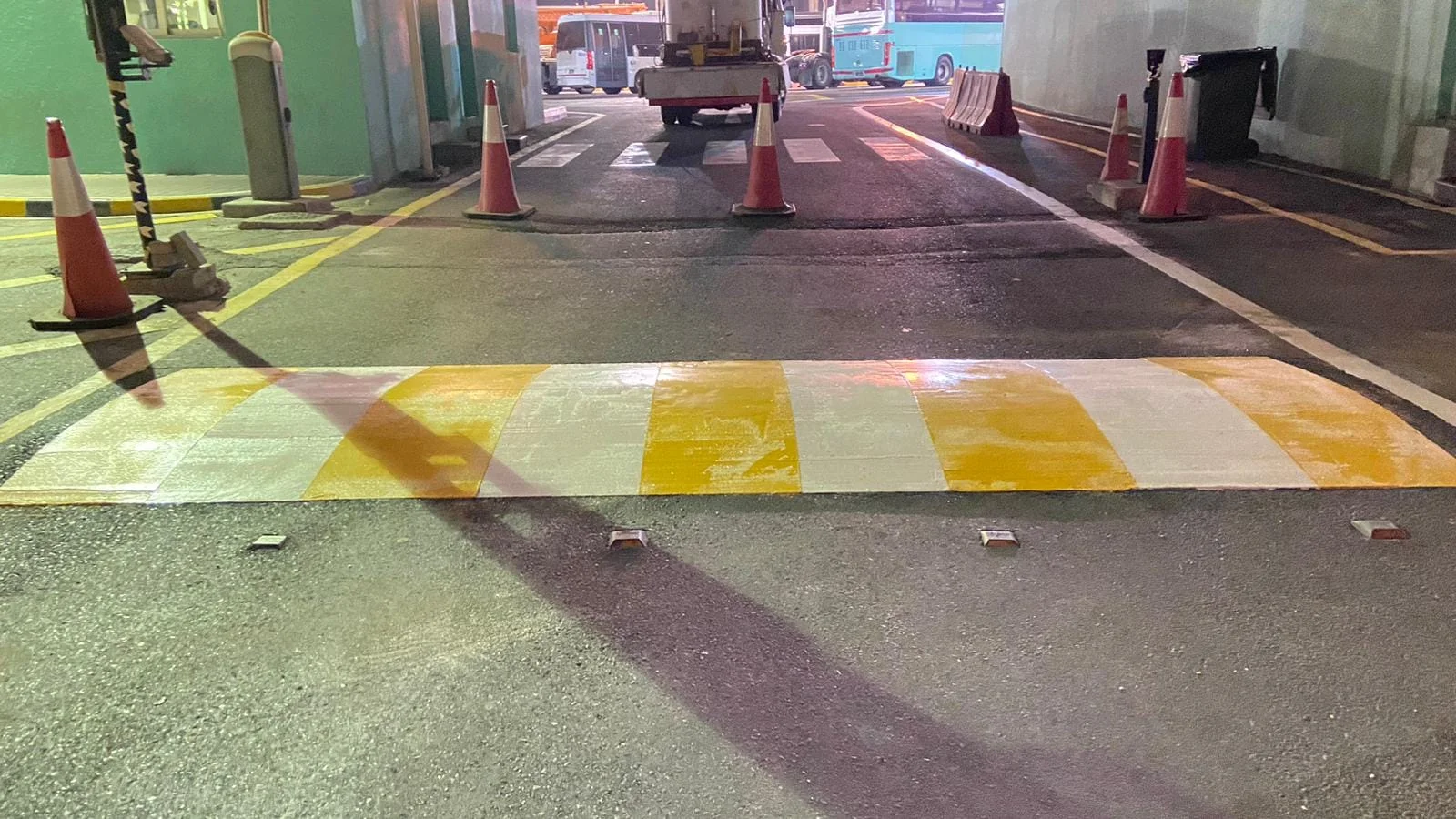
Qatar's extreme environmental conditions demand specialized road marking chemistry. Conventional cold solvent paints degrade, peel, and lose luminescence within months under intense UV radiation. Soft One's hot-applied thermoplastic delivers permanent thermal fusion.
Engineered with synthetic hydrocarbon binders that soften at 95°C and melt at 180°C–200°C. Upon application, the molten resin melts into the top asphalt bitumen layer, creating an inseparable mechanical anchor that resists heavy vehicle tire scrub.
Features 20% internal intermix glass beads (BS EN 1424) combined with automatic pneumatic drop-on glass micro-spheres (BS EN 1423 coated with silane). As the line wears naturally, new beads are exposed, sustaining nighttime luminance for 3+ years.
Incorporates premium Rutile TiO2 pigments providing superior whiteness index (Class B2) and UV stability. It resists solar chalking, yellowing, and asphalt oil migration even during Qatar's peak midsummer heat waves.
Soft One deploys computer-guided thermoplastic boiler trucks, self-propelled screed machines, and hand-operated line stripers tailored to each project's specifications.
The standard for urban roads, roundabouts, and pedestrian crosswalks in Doha. Screed shoes create razor-sharp edges and high film build, providing exceptional durability against stop-and-go braking friction.
Employed on high-speed expressways, Lusail corridors, and orbital highways. Provides consistent line thickness at high application speeds, paired with synchronized glass bead dispensing for uniform retroreflectivity.
Ideal for rapid highway re-marking, airport taxiways, and multi-lane logistics parks. High-pressure pneumatic spraying minimizes traffic closure windows while maintaining full QCS retroreflectivity compliance.
Soft One guarantees third-party certified laboratory testing adhering to BS EN 1436 / 1871 and Ashghal Interim Advice Notes.
| Parameter | Ashghal & QCS Standard | Soft One Specification | Verification Test Method |
|---|---|---|---|
| Application Temperature | 180°C – 210°C | 190°C ± 5°C controlled boiler | Digital Infrared Thermometer |
| Nominal Line Thickness | 2.0 mm – 3.0 mm | 2.5 mm Screed / 1.8 mm Spray | Elcometer Comb & Plate Gauge |
| Dry Retroreflectivity (RL - White) | ≥ 300 mcd/m²/lux (Class R4) | ≥ 350 – 420 mcd/m²/lux | Delta LTL-X Retroreflectometer |
| Dry Retroreflectivity (RL - Yellow) | ≥ 200 mcd/m²/lux (Class R3) | ≥ 230 – 280 mcd/m²/lux | Delta LTL-X Retroreflectometer |
| Skid Resistance Value (SRV) | ≥ 45 BPN | ≥ 50 – 55 BPN | British Pendulum Tester |
| Luminance Factor (β) | ≥ 0.70 (White) / ≥ 0.50 (Yellow) | Class B2 compliant | Spectrophotometer D65/10° |
| Curing & Solidification Time | ≤ 5 minutes at 35°C | 2 – 4 minutes | Tire Tracking In-Situ Test |
| Glass Bead Drop-On Density | ≥ 350 g/m² | 400 – 450 g/m² pressurized | Mass / Area Collection Box |
As Qatar's premier traffic safety and road marking contractor, Soft One operates complete turnkey road striping, kerb painting, and car park demarcation teams across all Qatar municipalities.
Comprehensive overview of Qatar road marking services, asphalt works, road signs, night operations, and Ashghal project capabilities.
High-contrast yellow/black hazard curbs, red/white regulatory boundaries, and roundabout border coatings in Doha.
Commercial parking bay striping, epoxy multi-deck coatings, EV charging bays, and directional arrow stencils.
Clear technical answers regarding specifications, Ashghal compliance, and application processes in Qatar.
Hot-applied thermoplastic melts at 180°C to 200°C and fuses thermally with the asphalt binder, creating an indestructible physical and chemical bond. Unlike conventional cold solvent paints that blister or chalk under Qatar's 50°C summer heat, thermoplastic maintains structural integrity, high luminance, and drop-on glass bead retention for 3 to 5 years.
For more details on complete highway works, view our main Road Marking Services in Qatar pillar page.
Thermoplastic road marking in Qatar must comply with Qatar Construction Specifications (QCS 2014 / 2018 Section 6), Ashghal Interim Advice Note IAN 014, BS EN 1436 (performance standards), BS EN 1871 (material physical properties), and AASHTO M249.
These require minimum 2.0 mm to 3.0 mm thickness, initial dry retroreflectivity (RL) ≥ 300 mcd/m²/lux for white markings, and skid resistance ≥ 45 BPN.
We combine premix glass beads (BS EN 1424, minimum 20% by mass inside the hot melt) with automated pressurized drop-on glass beads (BS EN 1423, treated with anti-dust silane and moisture-resistant coatings) applied at ≥ 400 g/m². This dual-action optical system ensures continuous retroreflectivity even as surface wear occurs.
Yes. On concrete road bridges, ramps, and aged oxidized asphalt, Soft One applies a high-tack synthetic hydrocarbon or epoxy tack-coat primer prior to thermoplastic screeding. This penetrates the substrate pores to guarantee maximum adhesion and prevents line delamination.
For municipal borders and curb works, see our dedicated Kerb Stone Painting Qatar services.
Thermoplastic markings cool and cure through thermal solidification within 2 to 4 minutes under typical Qatar ambient conditions. The treated road section can be reopened immediately to live vehicular traffic without risk of tracking or smearing.
